Sealy j, CC BY-SA 4.0 , via Wikimedia Commons


Sealy j, CC BY-SA 4.0 , via Wikimedia Commons
Renewable energy technologies incurred large cuts in government support last year with the passage of the “One Big Beautiful Bill Act” (OBBBA). The impact of the cuts are still rippling through markets.
In contrast, carbon capture, utilization and storage (CCUS) was a big OBBBA winner, receiving huge increases in subsidies. Although CCUS is frequently presented as a climate solution, the unfortunate reality is that current CCUS subsidies are first and foremost benefiting oil and gas.
Earth Track’s policy brief, Surging Subsidies for Enhanced Oil Recovery: High Taxpayer Cost, No Climate Benefit, documents the growing scale and poor structure of CCUS subsidies through the 45Q tax credit. 45Q has emerged as the main tax subsidy supporting the fossil fuel sector -- which will supply more than 90% of the anthropogenic CO2 through 2050 according to the US Energy Information Administration. To date, the CO2 that has been captured at great expense to US taxpayers has almost always been used for Enhanced Oil Recovery (EOR), a technique to extract additional oil from declining wells. Subsidizing EOR is a climate negative.
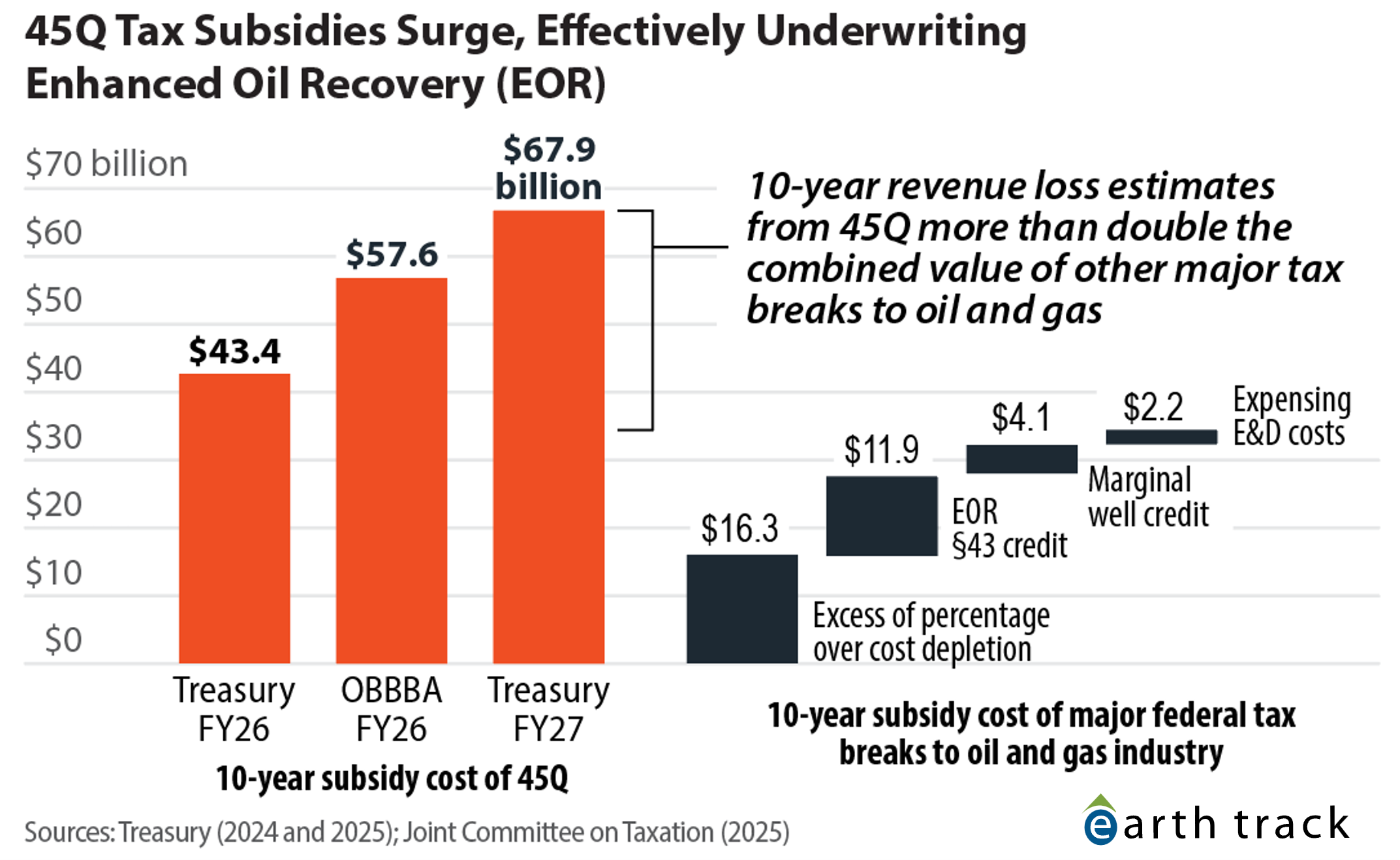
The US Treasury’s projected revenue losses from 45Q are growing rapidly, with a jump of nearly $25 billion since the passage of OBBBA, and now estimated at $67.9 billion over the 2026-2035 period. The estimated cost of 45Q greatly exceeds the projected cost of other tax breaks to oil and gas for that same time frame (see graphic below). Because the subsidy supports increased oil production, it undermines broader climate goals. Ending 45Q eligibility for enhanced oil recovery would stem this wasteful use of public resources that does little to address long-term decarbonization challenges.