The Keystone XL tar sands pipeline project, like all oil industry projects, benefits from substantial taxpayer subsidies. Some, like reduced property taxes, are directed at the pipeline itself. Others increase the viability of the pipeline by reducing the cost of the oil going into it, or the cost…
This analysis provides the first detailed accounting of oil and gas subsidies in Norway. The report finds that Norwegian government provided 25.5 billion Norwegian kroner (US$4 billion) in subsidies for upstream oil and gas activities in 2009.
The report uses the internationally recognized definition…
We all remember the Indiana Jones movie, where Evil Nazi Guy picks the wrong Holy Grail? Historically, the feds have chosen poorly too, says energy subsidy analyst Doug Koplow. Take biofuels: Washington has poured millions into energy from plants -- even though Koplow says the planting process…
Paul R. Epstein, Jonathan J. Buonocore, Kevin Eckerle, Michael Hendryx, Benjamin M. Stout III, Richard Heinberg, Richard W. Clapp, Beverly May, Nancy L. Reinhart, Melissa M. Ahern, Samir K. Doshi, and Leslie Glustrom
Posted on:
12/29/2011
Each stage in the life cycle of coal—extraction, transport, processing, and combustion—generates a waste stream and carries multiple hazards for health and the environment. These costs are external to the coal industry and are thus often considered “externalities.”We estimate that the life cycle…
For decades, wealthy countries have been using international aid and other foreign assistance—through grants, loans, equity and loan guarantees—to subsidize the expansion of the international fossil fuel industry. Many of these institutions provide export insurance as well.
Pennsylvania is subsidizing fossil fuels at a cost of almost $2.9 billion per year. Use of these fuels burdens taxpayers with additional non-monetized externalities such as air, land and water pollution and the associated negative human health and property impacts. Since many of these subsidies…
Burning Public Money for Dirty Energy presents an overview of how U.S. energy policies are creating a range of subsidies for municipal waste incineration (MSW) projects, including emerging waste burning technologies of gasification, pyrolysis and plasma arc incineration. This report also identifies…
The report provides an extremely detailed review of policies within France that have the effect of harming biodiversity, though does not rank these subsidies in terms of which are most damaging. The report looks at a vast array of policies that encourage urban sprawl, over-exploitation of resources…
Jehan Sauvage, Ronald Steenblik and Jagoda Sumicks, with input from Trevor Morgan, Michael Ash, James Greene and Jens Lundsgaard
Posted on:
10/4/2011
For the first time ever, the OECD has compiled an inventory of over 250 measures that support fossil-fuel production or use in 24 industrialised countries, which together account for 95% of energy supply in OECD countries. Those measures had an overall value of about USD 45-75 billion a year between…
Using data culled from the academic literature, government documents, and NGO sources, in this paper we examine the extent of federal support (as well as support from the various states in pre-Civil War America) for emerging energy technologies in their early days. We then analyze discrete periods…
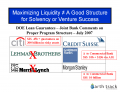
These six banks submitted comments to DOE on the Title 17 loan guarantee program in July of 2007 that resulted in much more favorable terms for lenders. Soon after, the financial crisis hit the US, and demonstrated that the banks had not done such a good job managing risk even in their own…
Mini Roy, Steven Greenwald, Jonathan Baliff, Alex Kroner, H. John Gilbertson Jr., Joseph Sauvage, Sylvia K. Barnes, Christopher Fink, Ray Spitzley
Posted on:
9/20/2011
"The six financial institutions below (Citigroup, Credit Suisse, Goldman Sachs, Lehman Brothers, Merrill Lynch and Morgan Stanley) are convinced that loan guarantees are an important tool, along with supportive state government policies, to enable the financing in the credit markets of new nuclear…
Jean-Marc Burniaux, Jean Chateau and Jehan Sauvage
Posted on:
9/8/2011
This report draws on previous OECD work to assess the impact on international trade of phasing out fossil fuel consumption subsidies provided mainly by developing and emerging economies. The analysis employed the OECD’s ENV-Linkages General-Equilibrium model and used the IEA’s estimates of consumer…
The UK operates 19 reactors that provided 15.7% of the country's electricity needs in 2010. The cost of supplying this electricity is cheap. The big six electricity suppliers make their profit from an industry which provides poor value for money to the taxpayer and leaves us with a toxic legacy that…
Autumn Hanna, Eli Lehrer, Benjamin Schreiber, and Tyson Slocum
Posted on:
8/29/2011
This year's Green Scissors report offers lawmakers and the public a starting place for spending reductions, including cuts to discretionary, mandatory and tax spending that also increase environmental protection. Perhaps even more importantly, Green Scissors 2011 offers a roadmap for how Congress…
Administered by the Department of Energy (DOE), the loan guarantee program encourages private investment in nuclear energy by lowering the cost of borrowing and possibly increasing the availability of credit for project sponsors—usually an individual utility, a consortium of utilities, or a…
Numerous energy subsidies exist in the U.S. tax code and have been there for up to a century. In certain cases the circumstances relevant at the time of implementation may no longer exist. Today, for example, the domestic fossil fuel industries (coal, oil, natural gas) are mature and highly…
Margaret Sheehan, Samantha Chirillo, Josh Schlossberg, William Sammons, Matt Leonard, Energy Justice Network
Posted on:
7/11/2011
American taxpayers and ratepayers are subsidizing a form of “renewable” energy—biomass electricity- that causes short and long-term harm to the public health and the environment. There are 234 of these so-called “clean and green” biomass electricity projects proposed for the U.S. The scale of these…
Despite surging prices for energy and other commodities, the vast majority of materials generated in the United States continues to be thrown away in landfills or burned in incinerators. This Webinar, prepared for the Product Stewardship Institute in Boston, provides an overview of the importance…